



Few artworks embody the ideals of the Renaissance quite like Michelangelo’s David. Sculpted between 1501 and 1504, this monumental figure of the biblical hero has become one of the most recognized symbols of human beauty, freedom, and artistic genius. Today, it remains one of the main reasons travelers visit Florence, eager to stand before the world’s most famous marble statue.
David represents far more than just the youthful hero who defeated Goliath. He reflects the spirit of Florence itself: courageous, intelligent, and determined to triumph against all odds.
Michelangelo’s David History: From a Block of Marble to a Masterpiece
The story of Michelangelo’s David begins decades before Michelangelo touched the marble. The original block — quarried in Carrara in 1464 — was meant for a statue to decorate the Florence Cathedral. Two sculptors, Agostino di Duccio and Antonio Rossellino, tried and failed to carve it, calling the marble too thin and flawed.
It remained abandoned for more than 25 years until a young Michelangelo Buonarroti, only 26 years old, accepted the challenge. Working in secret for over two years, he transformed that neglected stone into a monumental symbol of Renaissance humanism.
When unveiled in 1504, the statue stunned Florence. Citizens and artists alike saw in it a new ideal of beauty — not divine perfection imposed from above, but human perfection born from skill and intellect.
Why Is Michelangelo’s David So Famous?
Many depictions of David already existed before Michelangelo, including those by Donatello and Verrocchio. But Michelangelo’s version was revolutionary.
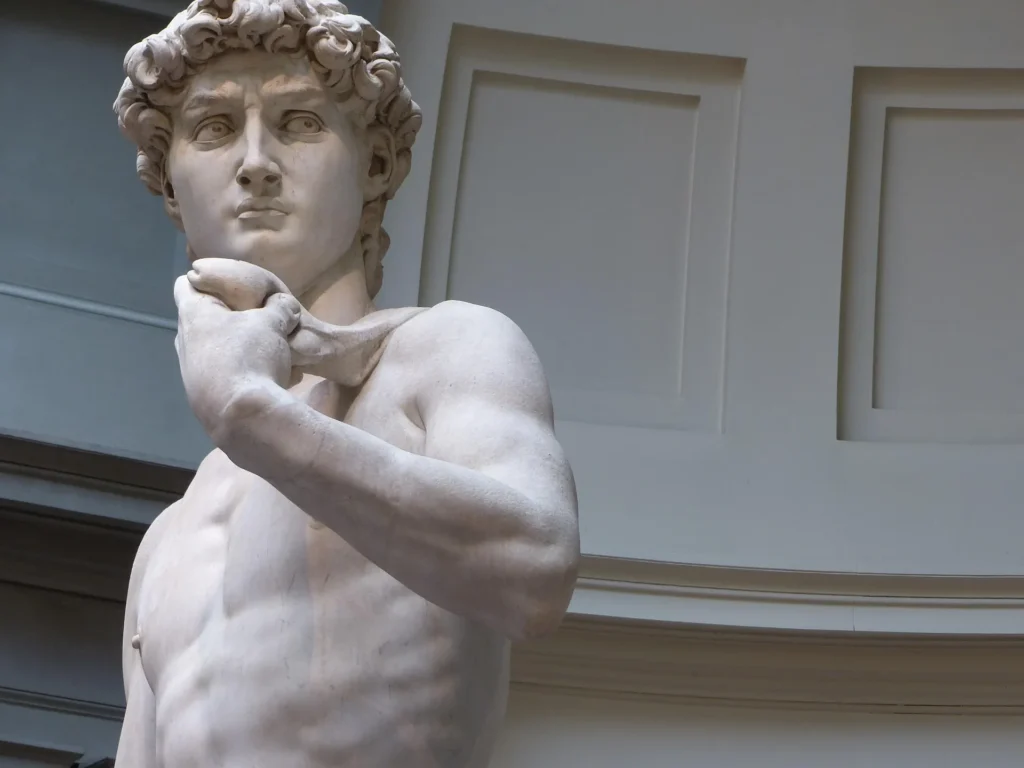
Instead of showing the hero after slaying Goliath, Michelangelo captured him before the battle — tense, alert, and ready. The veins in his hands, the focused gaze, and the subtle twist of his body (contrapposto) express both strength and thought.
This moment of psychological intensity was something entirely new. David became not just a hero of faith but an emblem of rational courage and human willpower.
The statue also symbolized Florentine independence. Just as David faced a giant, Florence — a small republic — saw itself as standing up to greater powers like the Papal States and the Duchy of Milan.
Michelangelo’s David Location: From Piazza della Signoria to the Galleria dell’Accademia
Originally, the statue was commissioned for the cathedral’s roofline. But after seeing its grandeur, the Florentine authorities decided it deserved a more prominent position.
In 1504, David was placed in Piazza della Signoria, in front of Palazzo Vecchio — the seat of the city’s government. There, he watched over Florence for centuries as a symbol of liberty and vigilance.
However, centuries of weather and damage took their toll. In 1873, the sculpture was carefully moved to the Galleria dell’Accademia, where it still stands today under a skylit dome designed specifically to honor it.
If you stroll through Florence, you can still see a perfect replica of David in Piazza della Signoria — the original spot that made him a civic guardian.
Michelangelo’s David Dimensions and Details: Anatomy Beyond Perfection
Michelangelo’s David stands 5.17 meters tall and weighs more than 5 tons. Yet what makes it extraordinary is not just its scale but the flawless illusion of life.
Michelangelo had an unrivaled understanding of the human body. He dissected cadavers to study muscles, tendons, and bone structure, applying this knowledge to his marble figures.
However, David isn’t anatomically perfect in a literal sense — and that’s intentional. Michelangelo exaggerated certain proportions to account for the viewer’s perspective:
- The head and hands are slightly larger than the body.
- The neck and torso are elongated to emphasize grace and power.
- The figure’s contrapposto pose (weight on one leg) adds tension and realism.
These choices make David appear perfectly balanced, ready to spring into motion — a fusion of ideal beauty and human imperfection that defines Michelangelo’s genius.
Michelangelo’s David Meaning: More Than a Biblical Hero
The biblical story of David and Goliath tells of a young shepherd defeating a giant warrior with only a stone and faith in God. Michelangelo reinterpreted this tale to fit Renaissance values.
Here, David is not just a religious figure but a representation of the triumph of intellect over brute force. His calm confidence embodies Florence’s belief in reason, courage, and freedom.
For Renaissance thinkers, David symbolized the potential of mankind — capable of greatness through thought, discipline, and creativity.
Interesting Facts About Michelangelo’s David
Even after 500 years, David continues to fascinate scholars, artists, and travelers. Here are some lesser-known curiosities:
- It was carved from a “flawed” block of marble. Experts called it unusable — Michelangelo proved them wrong.
- It was sculpted in complete secrecy. The artist built wooden fences around his workspace to prevent anyone from seeing the work until completion.
- Its left hand became a symbol of rebellion. After Florence lost its republican freedom in 1527, protesters waved replicas of David’s arm as a political gesture.
- It suffered damage in 1991, when a vandal struck it with a hammer, breaking part of the toes — later restored.
- There are three official replicas in Florence: in Piazza della Signoria, Piazzale Michelangelo, and at the Accademia (the original).
Where to See Michelangelo’s David Today
If you’re planning to visit Florence, you can admire the original David at the Galleria dell’Accademia, located on Via Ricasoli 58/60.
To make the most of your experience:
- Book skip-the-line tickets or a guided tour, especially in high season.
- Visit early in the morning or late afternoon to avoid crowds.
- Don’t miss the other Michelangelo works nearby, such as the Prisoners (Slaves) and St. Matthew, unfinished sculptures that reveal his creative process.
Outside, in Piazza della Signoria, the replica still guards the entrance of Palazzo Vecchio, while another stunning copy overlooks the city from Piazzale Michelangelo, offering one of Florence’s best panoramic views.
Visit Michelangelo’s David with Italy Pass Tour
To truly appreciate the magnificence of Michelangelo’s David, nothing compares to seeing it in person at the Galleria dell’Accademia. A guided visit allows you to understand not only the artistic mastery behind the statue but also its historical and cultural significance within Renaissance Florence.
With Italy Pass Tours, you can book a skip-the-line guided tour of the Accademia Gallery, ensuring a smooth and enriching experience. Expert guides will lead you through Michelangelo’s world — from the unfinished Prisoners to the awe-inspiring David — revealing hidden details and fascinating stories that most visitors miss.
Book your Accademia Gallery tour with Italy Pass Toursand immerse yourself in the timeless beauty of Michelangelo’s masterpiece.


